📌 QUICK ANSWER The NC-JCM Staff Side submitted its 51-page memorandum to the 8th Central Pay Commission on 14 April 2026. Key demands: minimum basic pay ₹69,000 (fitment factor 3.833), annual increment from 3% to 6%, HRA up to 40% for X-category cities, OPS restoration, age-based pension up to 100%, and 5 guaranteed financial upgradations in 30 years.
On 14 April 2026, the National Council – Joint Consultative Machinery (NC-JCM) Staff Side submitted a 51-page memorandum to the 8th Central Pay Commission.
According to 8thcpc.gov.in, the official website of the 8th Pay Commission, they have given 30th April as the last date for submission of the memorandum for unions. Before that, on 14 April, the National Council – Joint Consultative Machinery (NC-JCM) Staff Side submitted their memorandum. Shiv Gopal Mishra himself gave information on X (formerly Twitter) that he has submitted the memorandum to the 8th Pay Commission. So, all the demands they have made in their memorandum — the National Council demanded things like a 3.833 fitment factor, the Aykroyd formula, 6% annual increment, and many more,
we will tell you all their demands and also, you will get Official NC-JCM Staff Side Memorandum PDF.
Table of Contents
Who Is NC-JCM and Why Does Its Memorandum Matter So Much?
Before we get into what all demands have been made by NC-JCM before the 8th Pay Commission, we should talk about who NC-JCM actually is and why its memorandum matters so much.
The National Council – Joint Consultative Machinery (NC-JCM) is the apex body that represents all central government employees and pensioners in structured dialogue with the Union Government. You can consider it as the official collective bargaining table for the entire central government workforce — railway workers, postal employees, defence civilians, secretariat staff, CGHS doctors, Kendriya Vidyalaya teachers, CAPF personnel, and everyone in between.
So, when NC-JCM demands anything or writes anything to the Pay Commission, it is not only one union’s opinion of only NC-JCM, but it is like all federations, associations, and unions’ opinions being represented — all of them, okay.
That is why this 51-page NC-JCM Memorandum matters the most, and is this much important.
The 8th Central Pay Commission (8th CPC), for those who may not know, was constituted via Gazette Notification on 3 November 2025. Its Chairperson is Justice Ranjana Prakash Desai and there are even two more members……The Terms of Reference (ToR) give the Commission 18 months from constitution to submit its report, and after that, when the 8th Pay Commission is implemented, government employees’ salary and pension will be increased.
What NC-JCM Is Demanding in Their Memorandum (The Summary Table)
| What Is Being Changed | Current (7th CPC) | NC-JCM Demand (8th CPC) |
| Minimum Basic Pay | ₹18,000 | ₹69,000 |
| Fitment Factor | 2.57 | 3.833 |
| Annual Increment | 3% | 6% |
| HRA — X Cities (Delhi, Mumbai, Bengaluru etc.) | ~27% of basic | 40% |
| HRA — Y Cities (5L–50L population) | ~18% | 35% |
| HRA — Z Cities (below 5L population) | ~9% | 30% |
| Pension at retirement (65 years) | 50% of last pay | 70% of Last Pay Drawn |
| Pension at 90 years | Same 50% | 100% of Last Pay Drawn |
| Ex-gratia for duty death | ₹25 Lakhs | ₹2 Crore |
| Financial upgradations in 30 years | 3 (under MACP) | 5 (guaranteed) |
| Pension scheme | NPS / UPS | OPS (demanded) |
| Commuted pension restoration | After 15 years | After 11 years |
| Pension revision cycle | Every 10 years (with new CPC) | Every 5 years |
Demand 1: Minimum Pay ₹69,000 —The Number and the Science Behind It
This is most important and most talked demand in NC-JCM memorandum. In 7th pay commisison, level 1, means entry level cnetarl government emloyees BASIC SALARY is ₹18,000, in NC-JCM Memorandum, NC-JCM has demanded ₹69,000 Minimum Basic Pay.
The fitment factor proposed to achieve this is 3.833.
The formula is straightforward:
Revised Basic Pay = Current Basic Pay × Fitment Factor ₹18,000 × 3.833 = ₹68,994 ≈ ₹69,000
But here is the part most people — even central government employees — do not know: that this ₹69,000 rupees has not been chosen arbitrarily, but there is a science behind its calculation. NC-JCM used the Dr. Aykroyd Formula, which is the Supreme Court of India’s endorsed method for calculating minimum wages. Even in the 7th Pay Commission, the Dr. Aykroyd Formula had been used for calculating the ₹18,000 basic pay of the 7th Pay Commission.
How ₹68,947 Entry Level Basic Pay Was Calculated Using the Dr. Aykroyd Formula by NC-JCM.
The calculation is based on a family of 5 units (as per the Supreme Court’s Reptakos Brett judgment) at 2025 All-India average retail prices. Here is exactly what goes into that ₹68,947 figure:
| Component | Monthly Amount (₹) |
| Food — Rice/Wheat, Dal, Vegetables, Fruits, Milk, Meat, Fish, Eggs | ₹24,443 |
| Other food items (beverages, dry fruits, spices) @ 10% | ₹2,444 |
| Clothing (9.2 units @ ₹222 each) | ₹2,035 |
| Stitching charges | ₹3,000 |
| Detergents and household items | ₹655 |
| Subtotal: Basic essentials | ₹32,577 |
| Housing @ 7.5% of subtotal | ₹2,443 |
| Fuel, Electricity, Water @ 20% | ₹7,004 |
| Skills and capability provision @ 25% | ₹10,506 |
| Marriage, recreation, festivals @ 25% | ₹13,133 |
| Technology charges @ 5% | ₹3,283 |
| Grand Total | ₹68,947 |
| Rounded minimum pay | ₹69,000 |
| Fitment factor = ₹69,000 ÷ ₹18,000 | = 3.833 |
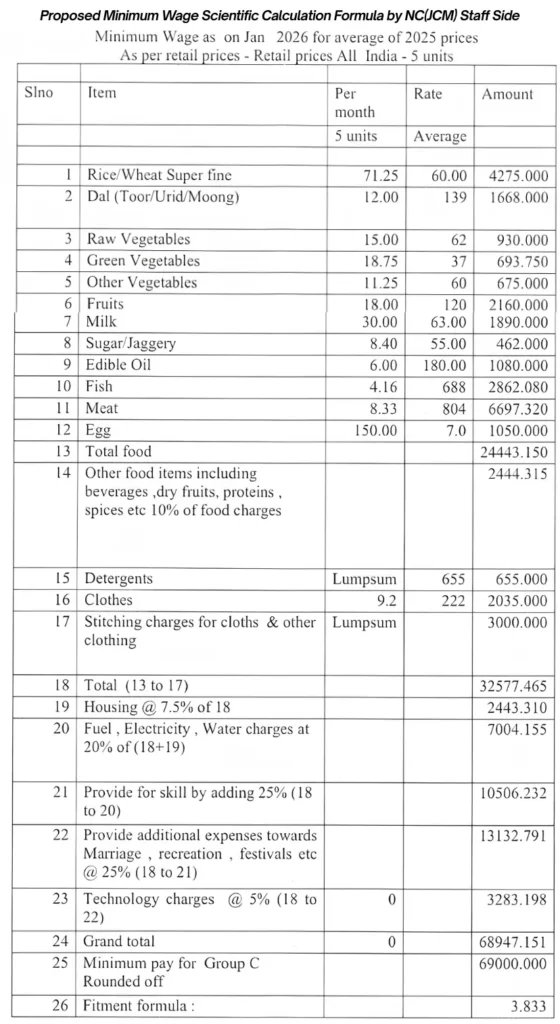
Notice something in that table — there is a line for technology charges. This is new. Previous Pay Commissions did not include this. NC-JCM’s memorandum explicitly demands a special technology allowance to cover digital devices, data, and connectivity costs. In an era where every government office runs on computers and every employee is expected to be digitally functional, this is not an unreasonable addition
8th Pay Commission Salary at Each Level Using 3.833 Fitment Factor
If the 8th Central Pay Commission or the Central Government accepts NC-JCM’s projected 8th Pay Commission fitment factor of 3.833, then what would be your 8th Pay Commission salary at each level.
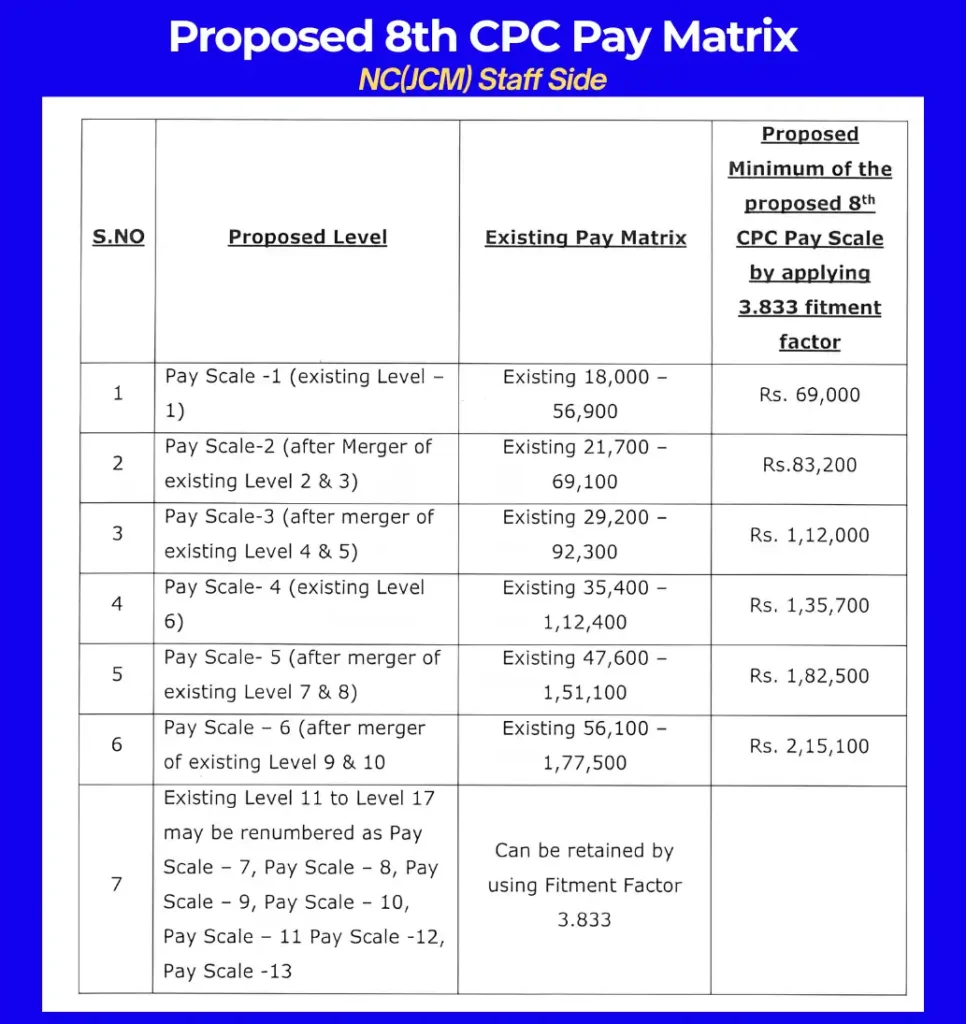
| Pay Level | Current Minimum Pay | Proposed Pay (×3.833) |
| Level 1 | ₹18,000 | ₹69,000 |
| Level 2 (merged with 3) | ₹21,700 | ₹83,200 |
| Level 3 (merged 4+5) | ₹29,200 | ₹1,12,000 |
| Level 4 (existing Level 6) | ₹35,400 | ₹1,35,700 |
| Level 5 (merged 7+8) | ₹47,600 | ₹1,82,500 |
| Level 6 (merged 9+10) | ₹56,100 | ₹2,15,100 |
Demand 2: Pay Scale Merger — Making the Pay Matrix Simpler and Fairer
If you have ever looked at the 7th CPC Pay Matrix table, there are 19 levels including 13A. NC-JCM’s memorandum proposes merging several of them into 13 pay scales.
The proposed mergers are:
- Level 2 + Level 3 → merged into one pay scale at Level 3
- Level 4 + Level 5 → merged into one pay scale at Level 5
- Level 7 + Level 8 → merged into one pay scale at Level 8
- Level 9 + Level 10 → merged into one pay scale at Level 10
- Special provision: Existing Level 5 employees to be upgraded and merged with Level 6 as a one-time measure
And why does NC-JCM in its memorandum want pay scale merger? Because according to them, there are employees at Level 2 whose pay is only marginally different from Level 3 employees, despite similar work. These level gaps create anomalies that have caused resentment for years. The merger addresses this directly — those at Level 2 effectively get elevated to Level 3 pay. In the central government employees’ workforce, there are hundreds of thousands of Group C employees across Railways, Posts, Defence, and Central Secretariat who are stuck at Level 5 for years. This one provision alone would benefit a massive section of the government workforce.
Demand 3: HRA Revision
Here is one question for you: When did you last time check what a 2-BHK costs to rent in Bengaluru or Delhi NCR? It is not ₹4,860 per month — which is what a Level 1 employee currently gets as HRA (27% of ₹18,000 = ₹4,860).
The current HRA rates were set in 2017. Since then, rents in metro cities have gone up between 80% and 120%. But there has been no increase in 7th Pay Commission HRA rates. A government employee posted in Gurugram or Koramangala on ₹4,860 HRA is either living very far from work or digging very deep into their basic pay to cover rent. Neither is a good situation.
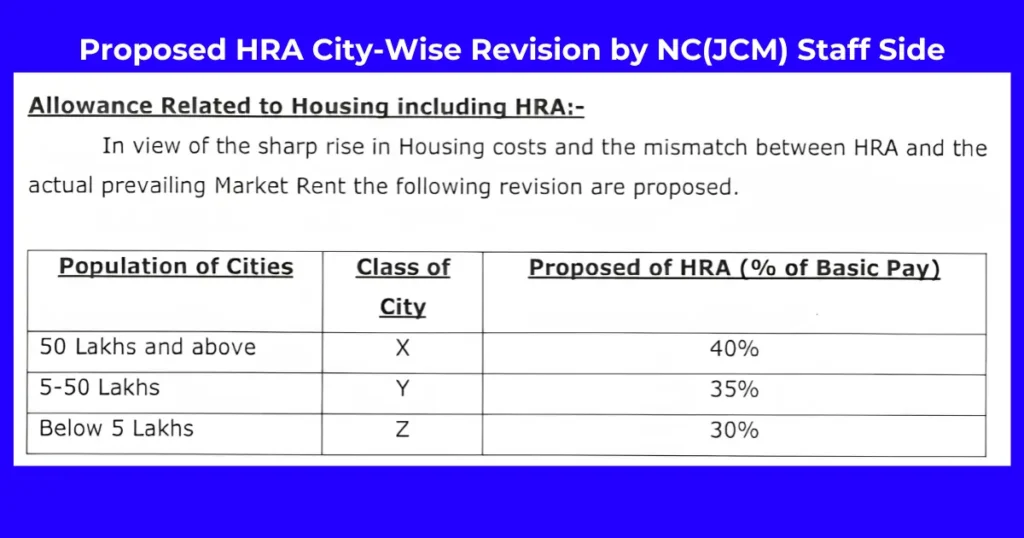
NC-JCM’s proposed revised HRA rates:
| City Category | Population | Current HRA (7th CPC) | Proposed HRA |
| X Cities | 50 Lakh and above | ~27% of basic | 40% |
| Y Cities | 5–50 Lakh | ~18% | 35% |
| Z Cities | Below 5 Lakh | ~9% | 30% |
X-category cities include Delhi, Mumbai, Kolkata, Chennai,Bengaluru, Hyderabad, Pune, and Ahmedabad. If you are a Level 6 employee (₹56,100 basic pay today) in Bengaluru getting the proposed revised pay, your HRA would be 40% of ₹2,15,100 = ₹86,040 per month.
HRA for Pensioners
According to NC-JCM, currently, pensioners get zero HRA. If you retired from government service and you are paying rent in a city, you get nothing towards it. NC-JCM wants HRA extended to pensioners living in rented accommodation.
This demand, if accepted by the Government of India, would affect lakhs of retired employees.
Demand 4: Age-Based Pension
NC-JCM has proposed Age-Based Pension :
| Age | Proposed Pension |
| 65 years (retirement) | 70% of Last Pay Drawn |
| 70 years | 75% of LPD |
| 75 years | 80% of LPD |
| 80 years | 85% of LPD |
| 85 years | 90% of LPD |
| 90 years | 100% of LPD |
Demand 5: Five Guaranteed Promotions in 30 Years
If you ask any Group C or Group B government employee about the one thing that frustrates them most about service, nine times out of ten they will not say the salary. They will definitely talk about promotions.
What is the current system regarding promotions? The current system provides career advancement through the MACP (Modified Assured Career Progression) scheme, which gives financial upgradations at 10, 20, and 30 years. Three upgradations over a 30-year career.
NC-JCM has demanded a complete restructuring of this:
| Upgradation | Year of Service Required |
| 1st Financial Upgradation | 6 years |
| 2nd Financial Upgradation | 12 years |
| 3rd Financial Upgradation | 18 years |
| 4th Financial Upgradation | 24 years |
| 5th Financial Upgradation | 30 years |
Five upgradations instead of three. And the first one comes at year 6 instead of year 10 What does it mean, meaning a young employee joining at Level 1 does not have to wait a full decade to see career progression,
Your pay moves to the next higher pay level, even if your designation remains the same. For employees who joined Level 2 (₹83,200 under proposed new matrix), five upgradations in 30 years would potentially take them to Level 7 purely through MACP — without a single formal promotion.
Demand 6: OPS Restoration — The Biggest Battle of This Pay Commission
On March 10, 2026, in Rajya Sabha Unstarred Question No. 1993, Shri Pradip Kumar Varma asked the government exactly how many employees are covered under NPS and OPS. Minister of State for Finance, Shri Pankaj Chaudhary, replied with this:
| Scheme | Pensioners |
| NPS (as on 31.01.2026) | 49,802 |
| OPS (as on 08.12.2025) | 69 Lakh (approx.) |
So here you yourself can see this, NPS covers barely 0.07% compared to OPS. That single number explains why every staff association, every WhatsApp group, every employee is demanding — bring back OPS.
OPS vs NPS vs UPS: The Plain Language Comparison
| Feature | OPS (Old Pension Scheme) | NPS (Since 2004) | UPS (Since April 2025) |
| Is the pension guaranteed? | Yes — 50% of last basic pay, fixed | No — depends on stock market returns | Partial — 50% guaranteed after 25 years |
| Does the employee contribute? | Zero | 10% of basic + DA | 10% of basic + DA |
| Government contribution | Fully funded | 14% | 18.5% |
| Market risk on retiree | None | Full | Partial |
| Family pension | Guaranteed | Market-linked | Guaranteed floor |
| What if markets crash in your retirement year? | Does not affect you | Devastating impact possible | Partial protection |
were given the option to migrate to UPS voluntarily. Out of approximately 26 lakh NPS employees eligible to switch, only 1.22 lakh chose to migrate to UPS — that is just 4.5%.
Read that again. 95.5% of NPS employees said no to UPS.
That is why NC-JCM’s demand is unambiguous: scrap NPS and UPS for central government employees. Revert all employees covered under NPS/UPS to the Old Pension Scheme under CCS Pension Rules 2021.
All the Other Key Demands (Full List)
NC-JCM’s 51-page memorandum does not stop at the six demands above. There is a comprehensive set of additional proposals that deserve attention. Here are the all other demans list,
| From the memorandum — Other Key Demands (full verified list): | |
| Annual increment | Annual increment raised to 6% |
| Risk & Hardship Allowance | ₹10,000 risk hardship allowance monthly |
| Transport Allowance | Transport allowance tripled |
| Children Education Allowance | CEA ₹10,000 per child |
| CEA extended level | CEA extended to post-graduation |
| Maternity Leave | Maternity leave 240 days |
| Menstrual Leave | Menstrual leave 3 days monthly |
| Parents Care Leave | Parents care leave introduced |
| Flight Entitlement | Flight entitlement all employees |
| House Building Advance | HBA ₹2 crore interest-free |
| Family unit definition | Family defined as 5 units |
| Technology allowance | Special technology allowance introduced |
| CGEGIS Group Insurance | CGEGIS group insurance revised |
| OROP for civilians | OROP extended to civilians |
| Commuted pension timeline | Commuted pension after 11 years |
| Pension revision frequency | Pension revised every 5 years |
| HRA for pensioners | HRA extended to pensioners |
| LTC for pensioners | LTC extended to pensioners |
| Cashless medical treatment | Cashless CGHS all employees |
| CGHS expansion | CGHS centres every district |
NC-JCM 8th Pay Commission Memorandum PDF
NC-JCM 8th Pay Commission Memorandum PDF has complete scientific minimum wage calculation, full proposed 13-level pay matrix, detailed HRA, Transport and other allowance revision proposals, pension reform framework including age based pensions table, OPS restoration arugment with legle citations and many more things,
Here is Official NC-JCM 8th Pay Commission Memorandum PDF
Frequently Asked Questions
What is NC-JCM Staff Side and why did it submit a memorandum?
NC-JCM (National Council – Joint Consultative Machinery) is the apex umbrella body representing all central government employees and pensioners in structured dialogue with the government of india. It submitted a 51-page memorandum to the 8th Central Pay Commission on 14 April 2026, representing the consolidated demands of all affiliated unions and associations — covering 48.62 lakh serving employees and 67.85 lakh pensioners.
What is the minimum pay proposed in the NC-JCM memorandum for 8th Pay Commission?
The minimum basic pay which has been proposed by NC-JCM in their memorandum is ₹69,000 per month for the lowest entry-level central government employee, This is derived from a scientific minimum wage calculation (₹68,947) using the Dr. Aykroyd formula for a family of 5 units at 2025 All-India retail prices. The fitment factor proposed to achieve this is 3.833.
What is fitment factor 3.833 in 8th Pay Commission?
Fitment factor 3.833 is the salary multiplier proposed by NC-JCM in their memorandum. It means a Level 1 employee whose current salary is ₹18,000 — if the government or Pay Commission accepts their proposed 3.833 fitment factor, then in the 8th Pay Commission, the revised salary of a Level 1 central government employee will be ₹69,000.
Will OPS be restored in 8th Pay Commission?
NC-JCM has unequivocally demanded OPS restoration, rejecting both NPS and UPS. The key data point: only 4.5% of eligible NPS employees (1.22 lakh out of 26 lakh) migrated to UPS when given the choice in 2025, showing everyone’s preference is for OPS. However, the government has made no commitment on whether they will restore OPS in the 8th Pay Commission.
How many promotions are guaranteed under the NC-JCM demand?
NC-JCM demands 5 guaranteed financial upgradations in a 30-year career — at 6, 12, 18, 24, and 30 years. This replaces the current MACP scheme that provides only 3 upgradations at 10, 20, and 30 years. The earlier first upgradation (year 6 vs year 10) is particularly significant for young joiners.
What is the proposed HRA in 8th Pay Commission by NC-JCM?
NC-JCM proposes: 40% of basic pay for X-category cities (50 lakh+ population: Delhi, Mumbai, Bengaluru, Chennai, Hyderabad, Kolkata, Pune, Ahmedabad); 35% for Y-category (5–50 lakh); and 30% for Z-category (below 5 lakh). This compares to current rates of approximately 27%, 18%, and 9% respectively.
What is the annual increment proposed in 8th Pay Commission?
NC-JCM has proposed 6% annual increment, means doubling the annual increment from 3% to 6% of basic pay.
How to download NC-JCM 8th Pay Commission memorandum PDF?
The memorandum is publicly available. Visit 8thpaycommissionsalarycalculator.com search “NC-JCM 8th CPC memorandum PDF 2026” —you can dowload it from here, The memorandum is 51 pages covering all pay, allowance, pension, and welfare demands.
The NC-JCM memorandum puts all of this on record. Whether every demand is accepted is a different question. But the fact that 1.16 crore government employees and pensioners now have a comprehensive, scientifically grounded, legally referenced document presenting their case — that matters.
Key Sources & Further Reading
- Official 8th Pay Commission Portal: 8cpc.gov.in
- NC-JCM Secretary Shiva Gopal Mishra’s confirmation tweet: @ShivaGopalMish1 (April 14, 2026)
- NC-JCM Staff Side Office: 13-C, Ferozshah Road, New Delhi
- Memorandum submission: 8cpc.gov.in (deadline 30 April 2026)
- Terms of Reference, 8th CPC: Gazette Notification dated 3 November 2025
- Chairperson, 8th CPC: Justice Ranjana Prakash Desai
- Member Secretary, 8th CPC: Shri Pankaj Jain, 7th Floor, Chanderlok Building, Janpath, New Delhi
This article is based on the NC-JCM Staff Side memorandum (April 14, 2026) and official 8th CPC communications. Final pay revision figures will depend on the Commission’s recommendations and Government acceptance. This is not financial advice.