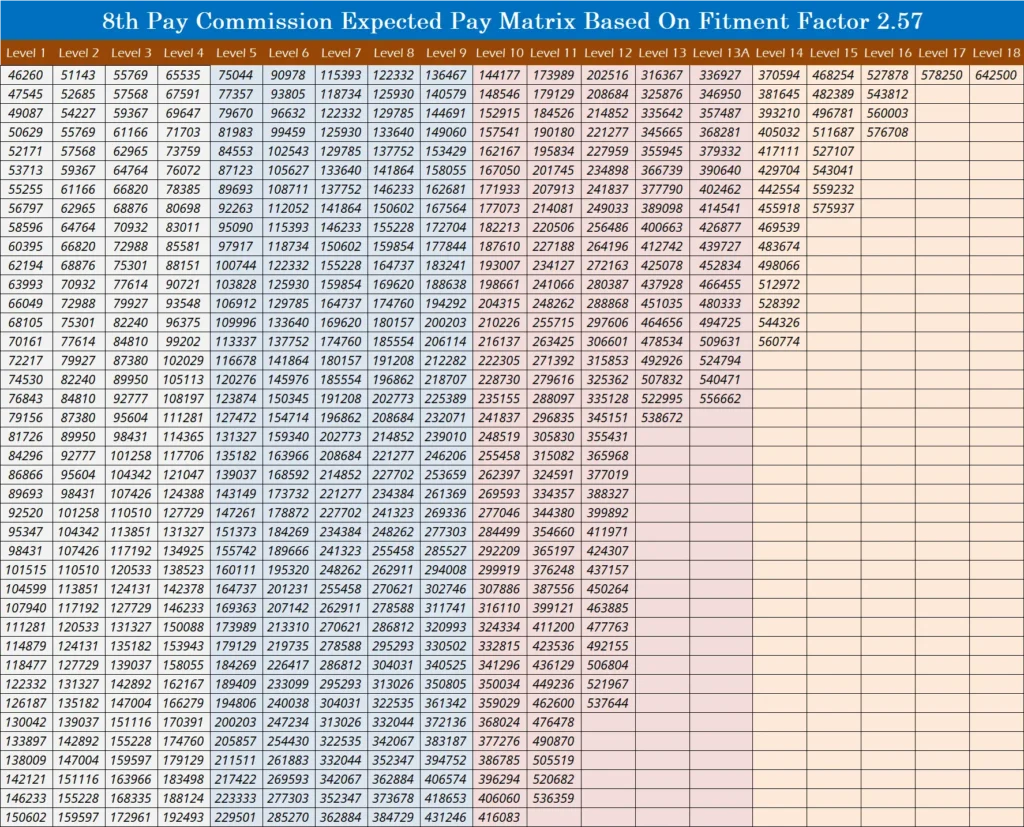
What is Pay Matrix?
The Pay Matrix is a table used by the Government of India to determine the salary of Central government employees. In this table, basic salary, the minimum and maximum salary, the number of stages, and the percentage increment in salary each year all are included.
The Pay Matrix was introduced to replace the previous system of grade pay and pay bands. In the 6th Pay Commission, there were grade pay and pay bands. For example, if an employee’s pay band was 23,700-42,200, it meant that their salary started at 23,700 and could increase up to 42,200, with an annual increment of 2-3%. However, there were many challenges with this Pay Band and Grade Pay system,
In the 7th Pay Commission, the grade pay and pay band system was ended. and has come Pay Matrix Table. in this Pay Matrix Table all level , level 1 to level 18 and all stages is given with annual increment.
So,7th Pay Commission, there is no longer any relevance to pay bands or grade pay.
Table of Contents
How does the Pay Matrix Table work?
The Pay Matrix table is structured horizontally and vertically. The rows represent the Stages , and the columns show different-different level. For example, for Level 1, the basic pay might be 18,000. After the increment in the second year, it could rise to 18,500. The rows show the increment at each stage.
3 Possible Methods for Calculating the New Basic Pay under the 8th Pay Commission
There are three methods to determine what the minimum pay or basic pay could be for the 8th Pay Commission Pay Matrix table.
Scenario 1: Based on Inflation and Consumer Price Index (CPI)
CPI tells us how much prices have gone up. For example, if last year you bought something for ₹100, and now the same thing costs ₹110, it means you need to spend 10% more money to buy the same item. So, if the government paid you ₹20,000 last year, and prices have increased by 10%, you would need 10% more money to buy the same things.
For instance, if your basic pay was ₹18,000 last year, with a 10% increase, it would go up by ₹1800, making it ₹19,800 this year. This is how the government looks at the changes in the Consumer Price Index (CPI) over the last 10 years to decide what the new pay matrix should be for the 8th Pay Commission.
Scenario 2: Average Increase from All Past Pay Commissions
As we know, the 6th Pay Commission resulted in a 54.0% increase in the salary. So, the second method for determining the new basic pay for the 8th Pay Commission is to calculate the average increase from all previous Pay Commissions.
So, to calculate average of all pay commission,

First, we will have to do sum all the values:

Now, divide the sum by the number of Pay Commissions from 2nd pay Commission to 7th Pay Commission :
If we assume that the average real increase for the 8th Pay Commission would be 26.95%, then the new basic pay for the 8th Pay Commission would be calculated by applying this percentage increase to the existing basic pay.
Substitute the values:

First, calculate the increase:

Now, add the increase to the old pay:
After a 26.95% increase, the new basic pay could be ₹22,851 for the 8th Pay Commission.
Scenario 3: Average of the Fitment Factor of the Last Two Pay Commissions
We have to calculate average of last two pay commission: 7th pay commission and 6th Pay Commission
- 6th Pay Commission (6th CPC): 1.86
- 7th Pay Commission (7th CPC): 2.57
Average Fitment Factor Calculation:
So, the average fitment factor of the 6th and 7th Pay Commissions is approximately 2.22.
This means the 8th Pay Commission’s fitment factor could be 2.22. As we know, the fitment factor is a multiplier. So, if we multiply the last 7th Pay Commission’s basic pay of ₹18,000 by the fitment factor of 2.22, we get ₹39,960.
Therefore, the new basic pay for the 8th Pay Commission could be ₹39,960, based on the average fitment factor of the last two Pay Commissions
8th Pay Commission Expected Pay Matrix Table |